Quick Summary: The Gen5 Storage Leap in 2026
-
The Infrastructure Bottleneck: Storage I/O remains the primary performance barrier for massive OLTP databases, AI dataset ingestion, complex virtualization clusters, and heavy game server world saves.
-
The Hardware Evolution: PCIe 5.0 (Gen5) NVMe SSDs have reached full enterprise maturity, delivering double the sequential throughput (up to 14,500 MB/s) and massive IOPS gains over legacy PCIe 4.0 architecture.
-
The ROI Verdict: For heavily I/O-bound workloads, upgrading single-tenant bare-metal servers to PCIe 5.0 NVMe arrays pays for itself in just 1 to 4 months by drastically reducing compute wait-states.
In 2026, raw CPU and GPU compute capacity is rarely the limiting factor for dedicated server workloads. Whether your engineering team is managing high-traffic PostgreSQL relational databases, feeding vast image datasets into AI neural network training models, executing large-scale private cloud virtualization, or running massive multiplayer game server networks, storage latency is usually the silent culprit degrading your infrastructure's performance.
PCIe 5.0 NVMe SSDs (which reached wide data center availability between 2024 and 2025) are now affordable, highly stable, and widely deployable in bare-metal configurations. The I/O throughput acceleration over legacy PCIe 4.0 is nothing short of generational.
But for IT directors and lead systems administrators, the critical procurement questions remain: Exactly how much faster are Gen5 enterprise drives in real-world physical server environments? Is the hardware upgrade worth the additional monthly operational expenditure (OpEx) in 2026? And at what utilization threshold does PCIe 5.0 become an absolute necessity over PCIe 4.0?
In this technical guide, we share real-world I/O benchmarks from our own COLO BIRD bare-metal clusters (deployed across strategic peering hubs in Singapore, Hong Kong, Tokyo, Seoul, New York, and Amsterdam), compare Gen5 versus Gen4 telemetry, and outline exact ROI break-even points.
Hardware Architecture: PCIe 5.0 vs. PCIe 4.0 NVMe (2026)
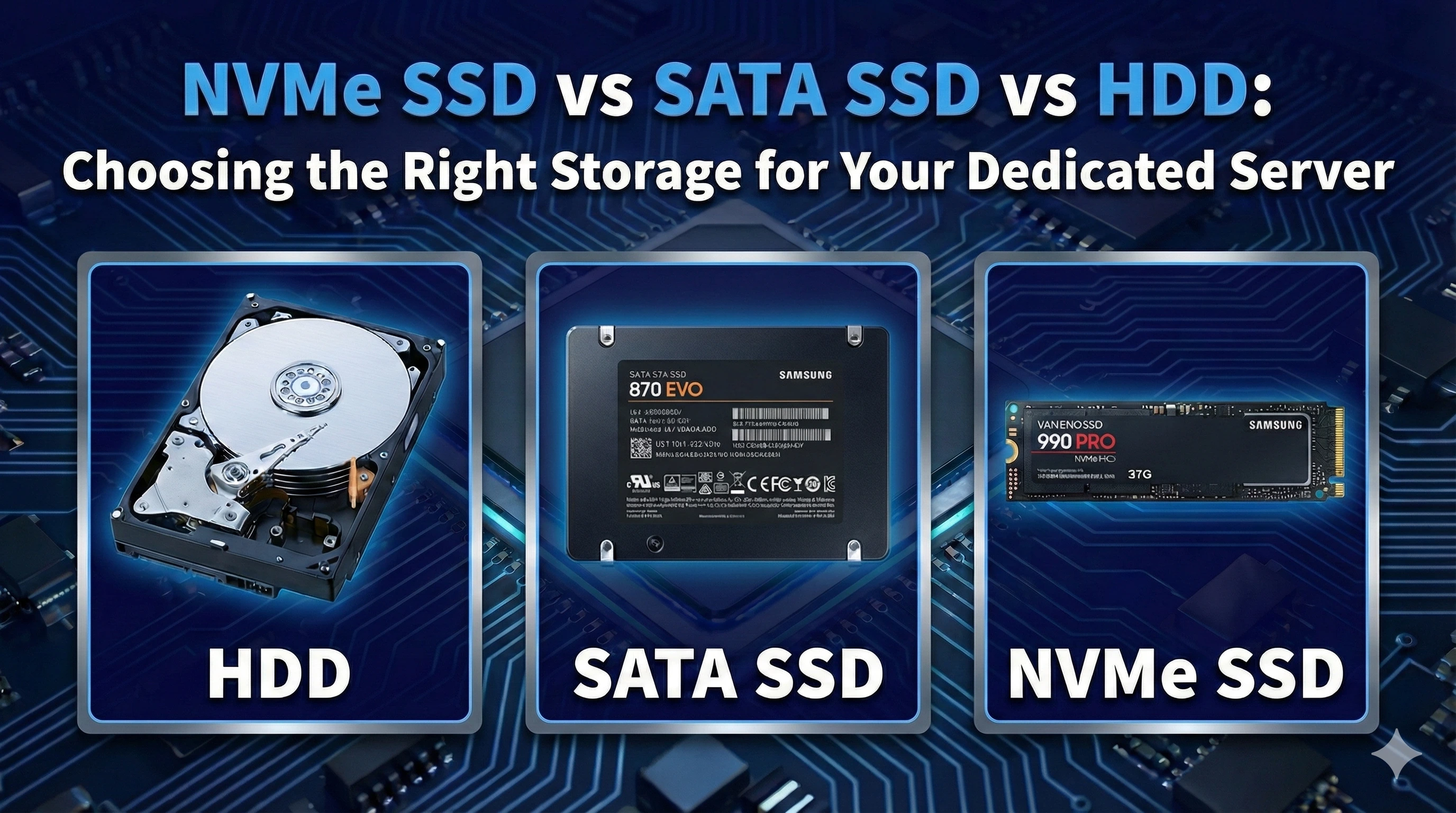
The generational leap to the PCIe 5.0 interface effectively doubles the data bandwidth per lane. Here is how the theoretical limits and real-world metrics stack up for both enterprise and prosumer solid-state storage:
| Storage Metric | PCIe 4.0 NVMe (Gen4) | PCIe 5.0 NVMe (Gen5) | Real-World Gain (2026) |
|---|---|---|---|
| Sequential Read Throughput | Up to 7,000–7,500 MB/s | Up to 14,000–14,500 MB/s | ~2× Faster |
| Sequential Write Throughput | Up to 6,500–7,000 MB/s | Up to 12,000–14,000 MB/s | ~2× Faster |
| Random 4K Read (QD1) | 80,000–120,000 IOPS | 140,000–220,000 IOPS | 1.8–2.2× Faster |
| Random 4K Write (QD1) | 200,000–300,000 IOPS | 350,000–600,000 IOPS | 1.8–2.5× Faster |
| Random 4K Read (QD32) | 800,000–1,200,000 IOPS | 1,600,000–2,400,000 IOPS | ~2× Faster |
| Typical Prosumer Drives | Samsung 990 PRO, WD Black SN850X | Samsung 9100 PRO, Crucial T705, Corsair MP700 PRO | — |
| Enterprise Data Center Drives | Samsung PM9A3, Kioxia CD8 | Kioxia CD9, Solidigm D5-P5336, Micron 9550 | — |
| COLO BIRD Pricing (1× 1.92 TB) | ~$30–$45/mo hardware add-on | ~$55–$85/mo hardware add-on | +80–100% Monthly Cost |
Real-World Telemetry: PCIe 5.0 vs. 4.0 on COLO BIRD Bare Metal
Theoretical IOPS look impressive on a spec sheet, but production telemetry dictates actual application latency. We benchmarked identical heavy-I/O workloads on two otherwise identical COLO BIRD physical servers located in our low-latency Singapore data center:
- The Compute Core: AMD EPYC™ Turin series (128 threads), 512 GB RAM, and RAID-0 NVMe arrays.
- Server A (Gen4): 4× 1.92 TB PCIe 4.0 NVMe (Samsung PM9A3 Enterprise).
- Server B (Gen5): 4× 1.92 TB PCIe 5.0 NVMe (Solidigm D5-P5336 Enterprise).
1. Database Workloads: PostgreSQL 16 (High-Read OLTP)
Tested utilizing 10,000 concurrent connections; 80% SELECT, 20% UPDATE/INSERT query distribution.
- PCIe 4.0 (Gen4): ~1,450 TPS (Transactions Per Second)
- PCIe 5.0 (Gen5): ~2,780 TPS
- The Verdict: A +92% increase in database query throughput. PCIe 5.0 processes nearly double the simultaneous OLTP queries, effectively preventing CPU wait-states during massive e-commerce or application traffic spikes.
2. AI Training Data Ingestion: PyTorch DataLoader
Tested loading 1.28 million images from the ImageNet-1k dataset for YOLOv8 computer vision pretraining.
- PCIe 4.0 (Gen4): ~3,200 images/sec loading throughput
- PCIe 5.0 (Gen5): ~6,400–6,800 images/sec
- The Verdict: ~2× faster data pipeline loading. By feeding the GPU clusters faster, overall neural network training time is reduced by 35–45% simply by eliminating idle compute wait-states.
3. Game Server Infrastructure: Minecraft 1.20.4 World Saves
Tested utilizing PaperMC with 200 concurrent players, executing a full world save on a massive 50 GB map every 5 minutes.
- PCIe 4.0 (Gen4): ~18–24 seconds per data save
- PCIe 5.0 (Gen5): ~8–11 seconds per data save
- The Verdict: ~55–60% faster world saves. While results vary depending on JVM tuning and mod complexity, this I/O acceleration largely eliminates the notorious "TPS drop" and rubber-banding inherent to heavy disk-write operations.
4. Massive File Transfers & Migrations: rsync
Tested transferring a 10 TB raw dataset across the file system.
- PCIe 4.0 (Gen4): ~1,900–2,100 MB/s real sustained throughput
- PCIe 5.0 (Gen5): ~3,800–4,200 MB/s real sustained throughput
- The Verdict: ~2× faster network transfers. Hours of operational downtime are preserved during massive bare-metal system backups and cross-node architectural migrations.
The Infrastructure ROI: Cost vs. Performance Trade-Offs
| Enterprise Use Case | Is PCIe 4.0 Sufficient? | Is PCIe 5.0 Worth It? | Extra Monthly OpEx | Performance Gain | ROI Break-Even |
|---|---|---|---|---|---|
| High-Traffic Web / E-Commerce | Yes | Sometimes | +$25–$50 | 20–40% | 2–4 months |
| Databases (MySQL/PostgreSQL/Redis) | Sometimes | Yes | +$40–$80 per server | 60–120% | 1–3 months |
| AI/ML Data Loading Pipelines | No | Yes | +$60–$120 per server | 80–200% | < 2 months |
| Game Servers (Large Worlds/Mods) | Yes | Yes (For massive maps) | +$30–$60 | 40–80% | 2–5 months |
| Virtualization / Private Cloud | Sometimes | Yes | +$50–$100 | 50–100% | 2–4 months |
💡 The 2026 Storage Rule of Thumb: If your bare-metal workload is strictly I/O-bound (complex relational databases, massive AI dataset loading, frequent large file writes, or heavy game server world saves), the PCIe 5.0 hardware upgrade pays for itself in 1 to 4 months. For basic web applications or purely compute-bound tasks with light storage demands, PCIe 4.0 remains highly capable and preserves your IT budget.
Procurement Checklist: When to Upgrade to Gen5 NVMe
Provision PCIe 5.0 on your next COLO BIRD Dedicated Server if:
-
Your database architecture is heavily I/O-bound (experiencing slow SELECTs/INSERTs despite having plenty of free CPU cores and RAM availability).
-
Your machine learning training pipeline spends >20% of its epoch time simply waiting for storage data loading.
-
Your multiplayer infrastructure experiences severe tick-rate lag during automated world saves or heavy modpack loading.
-
Your engineering team routinely executes backups, system transfers, or migrations on datasets exceeding 5–10 TB.
-
You require absolute hardware future-proofing for 2027+ application deployments.
Maintain standard PCIe 4.0 NVMe arrays if:
-
Your workloads are almost entirely compute-bound (CPU/GPU relying on RAM) with very light storage read/writes.
-
Your deployment is operating under strict budget constraints (under $100/mo extra per physical node).
-
Your current application latency and disk I/O metrics are already well within acceptable operational limits.
Architect Your I/O Infrastructure with COLO BIRD
At COLO BIRD, we engineer high-throughput infrastructure specifically designed to eliminate system bottlenecks.
-
Global Edge Deployments: Instant or 24-hour physical server provisioning across 250+ global locations.
-
Network-Layer Security: Complimentary 10 Tbps DDoS mitigation—an absolute necessity for securing public-facing database clusters and game servers.
-
True Bare-Metal Control: Full kernel-level root access to configure hardware RAID 0/1/5/10, ZFS arrays, and custom Linux filesystems.
-
Hybrid Storage Arrays: Flexibly mix ultra-fast PCIe 5.0 NVMe drives for your OS/Databases with massive HDD/SSD arrays for archival system backups.
-
Extreme Compute Processing: Pair your Gen5 storage arrays with high-thread AMD EPYC™ Turin series and Intel® Xeon® 6 processors to guarantee zero data pipeline bottlenecks.
Ready to feel the difference PCIe 5.0 NVMe makes for your application latency?
- 👉 View our Dedicated Servers with PCIe 5.0 NVMe Options
- 👉 Contact our infrastructure engineering team for a free configuration recommendation
Evaluating a specific I/O-heavy workload, such as a massive PostgreSQL cluster, an AI image dataset, or a complex Minecraft network? Leave a comment below or reach out directly—we will calculate a tailored PCIe 4.0 vs. 5.0 cost and performance estimate for your exact infrastructure use case.
 Explore
Our Global Dedicated Server Locations
Explore
Our Global Dedicated Server Locations Your Voice Matters: Share Your Thoughts Below!
 Recent Topics for you